

|
Getting your Trinity Audio player ready...
|
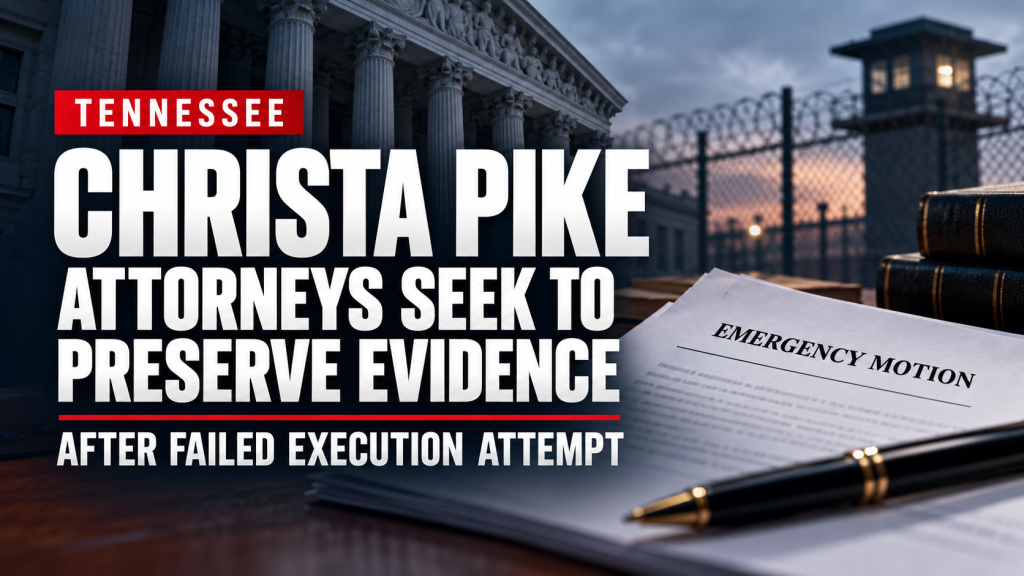
NASHVILLE, Tenn. (BFMG) — Attorneys for Christa Pike have asked a Tennessee judge to order prison officials to preserve all evidence related to the state’s failed September 30 execution attempt, alleging that problems with intravenous access caused severe injuries they had warned about months earlier.
The emergency motion, filed October 2 in Davidson County Chancery Court, seeks preservation of physical evidence, documents and electronic records related to the procedure. Her attorneys argue that potential litigation over alleged constitutional violations makes preservation essential.
According to the filing, the execution team used at least seven needles while attempting to establish IV access. Pike’s attorneys say she offered guidance about where to insert a needle and that one needle was bent at a 90-degree angle when removed.
The motion alleges that officials administered both the primary and backup sets of pentobarbital, amounting to two lethal doses, while Pike could be heard crying, whimpering and breathing loudly.
At one point, she said, “my arm feels like it’s about to burst open,” according to the filing.
Her attorneys contend that officials failed to establish or maintain properly functioning IV lines, allowing the drug to leak into surrounding tissue — a complication known as extravasation. They allege the execution team failed to recognize the problem before administering another dose.
Those assertions have not been established as findings by the court.
The motion describes Pike’s condition as of October 1, when her attorneys said she was unconscious, intubated and on a ventilator at a Nashville-area hospital. Both arms were swollen, burned and blistered, according to the filing.
In a subsequent October 6 statement, her attorneys said Pike was conscious and speaking but continued to receive critical medical care. They said her prognosis remained uncertain and anticipated a lengthy recovery.
The motion argues that Pike had warned the court about these risks approximately nine months before the execution attempt. Her earlier complaint cited small veins, thrombocytosis and a history of difficulty with blood draws and needle insertion as factors that could interfere with delivery of the execution drug.
That complaint also challenged the protocol’s provisions for medical treatment and resuscitation after a failed execution.
The attorneys raised additional questions about when the pentobarbital was prepared. They argue that, if officials followed the protocol’s morning preparation schedule, syringes could have remained unused for approximately 12 hours while a court-ordered stay delayed the execution.
The filing does not establish that the drug lost potency during that period.
Pike’s attorneys say they notified the state’s lawyers of their duty to preserve evidence early the morning after the execution attempt and later provided a detailed preservation list. As of the October 2 filing, they said they had received no response.
In an October 6 response, however, attorneys for the Tennessee attorney general’s office argued that a preservation order was unnecessary because the prison system already had obligations to retain the evidence in other cases..
Pike was sentenced to death for her role in the 1995 murder of 19-year-old Colleen Slemmer.
The emergency motion seeks to safeguard evidence for further legal proceedings. It does not itself request damages, overturn Pike’s conviction or ask the court to commute her sentence.
The hearing is scheduled to begin at 11:00 a.m. CT with a press conference from Pike’s attorneys to follow.
Powered By EmbedPress




















